Abstract Geometric Shape Monoline 03: A Refined Monoline Option for Designers and Brand Builders
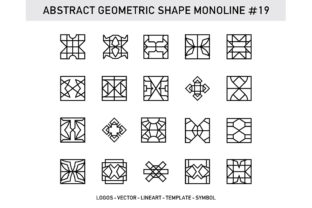
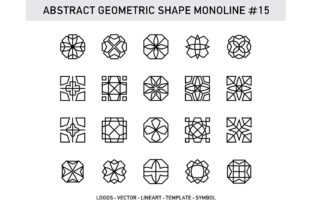
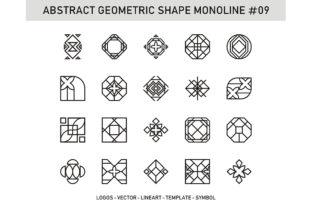
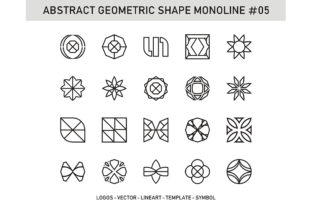
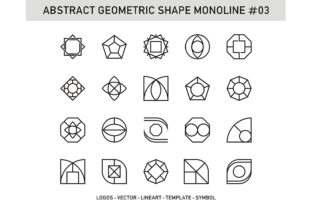
Abstract Geometric Shape Monoline 03 is a precision-crafted vector-based design asset consisting of a single, continuous, unbroken line that traces an intentionally balanced geometric composition. Unlike layered or filled illustrations, it belongs to the monoline family—defined by uniform stroke weight, no variation in thickness, and deliberate minimalism. Its structure combines angular symmetry with subtle curvature, resulting in a shape that reads as both modern and timeless. It’s not merely decorative; it functions as a foundational visual element—suitable for logos, pattern building, app icons, watermarking, or editorial illustration where clarity and scalability matter.
What Sets Abstract Geometric Shape Monoline 03 Apart
The distinction lies in its structural discipline and intentional restraint. While many abstract geometric assets rely on bold contrast, gradients, or overlapping forms, Abstract Geometric Shape Monoline 03 achieves visual impact through economy: one stroke, one path, zero fill. This makes it inherently adaptable across color schemes and backgrounds—no need to adjust stroke/fill ratios or manage transparency layers. Its EPS file retains full editability in vector environments (Adobe Illustrator, Affinity Designer), allowing designers to scale infinitely, recolor non-destructively, or integrate cleanly into larger systems. The accompanying high-resolution JPG provides immediate usability for mockups, presentations, or web previews without requiring vector software.
Compared to generically labeled “abstract geometric vectors,” Abstract Geometric Shape Monoline 03 avoids visual noise. It doesn’t include extraneous nodes, redundant anchor points, or inconsistent curve tension—common issues in mass-produced assets that complicate editing or output. Its path is optimized: clean, closed (where appropriate), and logically ordered. That matters when exporting to SVG for web use or prepping for laser cutting, embroidery digitizing, or CNC routing—formats where path integrity directly affects production fidelity.
How It Compares Across Common Use Cases
Designers evaluating Abstract Geometric Shape Monoline 03 often weigh it against three broad categories: hand-drawn monoline assets, multi-stroke geometric vectors, and AI-generated abstract shapes. Each has tradeoffs.
- Hand-drawn monoline assets offer organic texture and irregularity—valuable for branding aiming for warmth or artisanal authenticity. But they rarely scale cleanly at small sizes, and their imperfections can hinder technical applications like UI iconography or precision manufacturing. Abstract Geometric Shape Monoline 03 sacrifices that texture for consistency and reproducibility.
- Multi-stroke geometric vectors (e.g., shapes built from separate lines or compound paths) give more flexibility in animation or selective styling—but introduce complexity. Adjusting stroke alignment, managing layer order, or exporting for constrained platforms (like certain CMS templates or email clients) becomes more involved. Abstract Geometric Shape Monoline 03 simplifies that workflow by design.
- AI-generated abstract shapes may produce novelty quickly, but often lack intentionality in proportion, rhythm, or negative space balance. They’re also less likely to be production-ready: paths may be ungrouped, strokes inconsistently applied, or files bloated with unnecessary metadata. Abstract Geometric Shape Monoline 03 arrives vetted—tested for real-world application, not just aesthetic novelty.
Strengths and Practical Tradeoffs
Its primary strength is interoperability. Because it’s delivered in both EPS (editable vector) and JPG (raster preview), it bridges workflows. A brand strategist can drop the JPG into a client pitch deck while the lead designer opens the EPS to adapt it for a responsive logo lockup. That dual-format delivery reduces friction between stakeholders who use different tools or operate at different stages of a project.
However, this simplicity carries limitations. Abstract Geometric Shape Monoline 03 does not support variable stroke weights, dashed patterns, or gradient strokes out of the box—those require manual modification post-download. It also doesn’t include alternate versions (e.g., mirrored, rotated, or color-varied variants), so teams needing multiple configurations will need to generate those internally. And while its geometry is balanced, it isn’t neutral: the composition leans toward structured asymmetry—not pure symmetry or randomness—so it may feel too directional for projects seeking ambiguity or maximalist energy.
When Abstract Geometric Shape Monoline 03 Fits—and When It Doesn’t
This asset excels in contexts where legibility, scalability, and system integration are priorities. Consider it for:
- A SaaS company building a modular design system where icons and marks must scale from favicon (16×16 px) to billboard (10 m wide) without visual degradation;
- An apparel brand developing a minimalist logo lockup that will appear embroidered on fabric, debossed on leather, and animated in a mobile app tutorial;
- An editorial team creating a recurring visual motif for a tech publication—used across article headers, social thumbnails, and newsletter banners—where consistent rendering across devices and platforms is non-negotiable.
Conversely, Abstract Geometric Shape Monoline 03 may fall short if your project requires:
- Expressive line variation: If stroke tapering, pressure sensitivity, or calligraphic nuance is central to your visual language, a true monoline asset won’t deliver that dimension.
- Rapid iteration across dozens of variants: While editable, generating 20+ rotated or color-shifted versions manually takes time. In fast-paced branding sprints, pre-built variant packs—or parametric tools—may accelerate delivery.
- Contextual responsiveness: Unlike SVGs with CSS-driven interactivity or media queries, Abstract Geometric Shape Monoline 03 is static. It won’t adapt stroke width based on screen size or change form on hover unless wrapped in custom code.
Real-World Application Notes
In practice, designers often use Abstract Geometric Shape Monoline 03 as a starting point—not an endpoint. One UX studio integrated it into a dashboard icon set by pairing it with standardized grid-aligned strokes and consistent corner radii, ensuring visual harmony across 47 interface elements. Another packaging team used the EPS file to generate embossing dies: the clean path translated directly into CNC toolpaths with no cleanup needed, saving roughly half a day of prepress labor per SKU.
For those evaluating alternatives, consider how much control you need over the final output. If your process relies heavily on automation—such as batch-generating social assets via scripting—the EPS format supports that. If your team works primarily in Figma or Sketch and rarely touches vector paths, the JPG may suffice for early-stage exploration—but limits downstream flexibility.
Making an Informed Choice
Abstract Geometric Shape Monoline 03 isn’t about being “the best” abstract shape—it’s about being reliably fit-for-purpose. Its value emerges not in isolation, but in context: when paired with disciplined typography, thoughtful color application, and consistent spacing, it reinforces clarity rather than competing with it. It rewards attention to detail in implementation and offers diminishing returns if dropped into a chaotic visual environment without intentional integration.
Before downloading, ask: Does your current or upcoming project demand scalability across physical and digital outputs? Do your collaborators need both editable and preview-ready formats? Is visual consistency more critical than expressive variation? If two or more answers are yes, Abstract Geometric Shape Monoline 03 warrants serious consideration—not as a shortcut, but as a considered component in a broader design strategy.