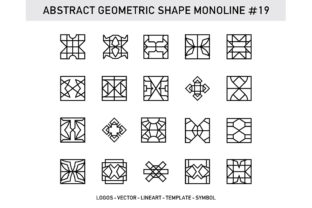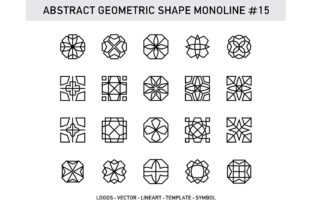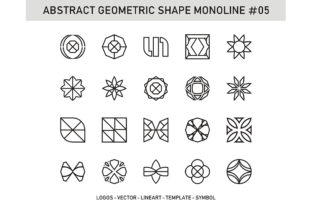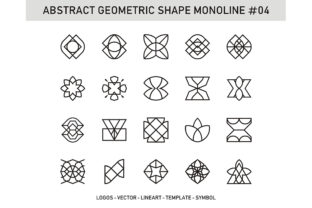
Abstract Geometric Shape Monoline 09: A Versatile Vector Resource for Precision Design Workflows
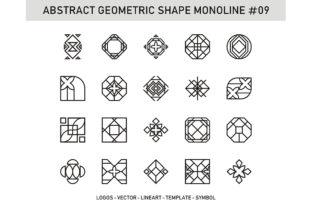
Abstract Geometric Shape Monoline 09 represents a refined iteration within the broader category of minimalist vector assets—specifically, a single-weight, clean-lined geometric composition designed for scalability and stylistic cohesion. Unlike illustrative or decorative shape sets, this asset prioritizes structural clarity, mathematical balance, and typographic-grade consistency in stroke weight and curvature. Its monoline construction—where every element shares an identical stroke thickness—ensures visual harmony across scales, mediums, and color treatments. This isn’t merely a decorative flourish; it’s a functional design component engineered for integration into systems where legibility, reproducibility, and adaptability are non-negotiable.
Core Characteristics That Define Its Utility
At its foundation, Abstract Geometric Shape Monoline 09 features a deliberate arrangement of interlocking or rhythmically spaced forms—such as asymmetrical polygons, tapered arcs, and offset concentric rings—that avoid literal representation. There are no organic curves or variable weights. Instead, each contour is generated using Bézier paths with tightly controlled anchor placement, resulting in crisp edges and predictable rendering at any resolution. The geometry adheres to proportional logic: ratios between segments often follow subtle Fibonacci approximations or modular grid relationships, lending intuitive visual rhythm without overt symmetry.
The “09” designation signals versioning—not arbitrary numbering—but reflects iterative refinements based on real-world usage feedback. Earlier variants exhibited minor alignment inconsistencies at sub-pixel sizes or subtle joins that could produce faint artifacts in print overlays. Version 09 resolves these through path simplification, optimized node distribution, and strict adherence to even-integer stroke values (e.g., 0.75pt instead of 0.732pt), ensuring reliable output whether rendered on a 4K display or a 300-dpi letterpress plate.
Why File Format Choice Matters in Practice
The availability of both .EPS and .JPG files addresses fundamentally different stages of the creative workflow—and misunderstanding their roles can compromise output quality.
- .EPS (Encapsulated PostScript): This vector format preserves every path, anchor, and stroke attribute natively. Designers can scale Abstract Geometric Shape Monoline 09 infinitely without degradation, recolor individual segments, adjust stroke alignment (center, inside, outside), or export subsets as SVG for web use. It integrates seamlessly into Adobe Illustrator, Affinity Designer, CorelDRAW, and professional prepress pipelines. For branding teams building scalable icon systems or educators developing modular lesson visuals, .EPS is the authoritative source file.
- .JPG (Joint Photographic Experts Group): A raster derivative—typically delivered at 300 DPI and multiple dimensions (e.g., 2400×2400 px, 4800×4800 px). It serves immediate application needs: embedding in PowerPoint presentations, adding to blog posts, placing in printed brochures where vector support is unavailable, or previewing layout options before committing to vector edits. Importantly, the JPG is not a conversion afterthought—it’s manually refined to eliminate anti-aliasing halos, ensure neutral background transparency simulation (via white fill), and maintain tonal fidelity across CMYK and sRGB workflows.
Crucially, neither file replaces the other. Using the JPG as a base for further vector editing introduces pixelation, interpolation errors, and irreversible loss of path intelligence. Conversely, opening the EPS in a non-vector editor like Photoshop for quick tweaks risks accidental rasterization—eroding the very precision the asset was built to deliver.
For Educators and Instructional Designers
In STEM education, Abstract Geometric Shape Monoline 09 functions as a neutral visual scaffold. Its balanced asymmetry avoids cultural or linguistic associations, making it ideal for diagramming abstract concepts—like network topologies, molecular bond angles, or data flow sequences—without distracting ornamentation. One university physics department uses scaled instances of the shape to represent quantum state transitions in lecture slides; because the .EPS retains editability, instructors modify stroke color per energy level and layer annotations directly over paths without misalignment.
For Brand Strategists and Identity Designers
Monoline geometry excels in foundational identity systems where flexibility across touchpoints is critical. A regional healthcare cooperative adopted Abstract Geometric Shape Monoline 09 as the underlying motif for its visual language—not as a logo, but as a repeating pattern in wayfinding signage, EHR interface icons, and patient education handouts. Because all elements share uniform stroke weight, the shape renders equally legibly on a 6-inch tablet screen and a 12-foot lobby wall. Designers extracted individual contours from the EPS to build a custom icon set, ensuring visual continuity no template library could guarantee.
For Researchers and Data Visualizers
In academic publishing, figure clarity is paramount—and journal submission guidelines often restrict embedded fonts or complex vector effects. Abstract Geometric Shape Monoline 09 provides a reproducible, license-free compositional anchor. A climate research team used rotated and mirrored variants of the shape to encode regional temperature anomaly clusters in a peer-reviewed journal graphic. Since the EPS imports cleanly into LaTeX via pdfpages or Inkscape-exported PDF, no manual redrawing was needed during typesetting—preserving exact proportions referenced in the methodology.
For Small Business Owners and Marketing Generalists
Time-constrained creators benefit from the asset’s plug-and-play readiness. A local ceramics studio incorporated the shape into packaging labels by placing it behind product photography in Canva—using the high-res JPG for speed, then switching to the EPS when preparing dieline files for their printer. No design software expertise was required for initial use, yet the vector file ensured professional output when scaling up for trade show banners.
Technical Considerations Before Implementation
While broadly compatible, thoughtful deployment prevents common pitfalls:
- Color Mode Consistency: The EPS embeds no color profile by default. Always assign your project’s working space (e.g., CMYK for print, RGB for digital) before applying fills. Avoid relying on “auto-convert” features in older software versions—they may shift perceived hue in gradients or transparencies.
- Stroke Alignment in Complex Layouts: When layering Abstract Geometric Shape Monoline 09 with text or photography, verify stroke alignment settings. Center-aligned strokes may visually recede; inside-aligned strokes reinforce boundaries but reduce internal negative space. Test at final output size—what reads clearly at 100% zoom may blur at 12pt type height.
- JPG Background Handling: Though delivered on white, the JPG contains no alpha channel. For transparent backgrounds in web use, manually remove the white layer in Photoshop or convert to PNG—but retain the original JPG for print-safe color matching. Never re-save the JPG after edits; generation loss compounds with each compression cycle.
- Version Control Discipline: If modifying the EPS (e.g., splitting paths, adding gradients), save derivatives with descriptive names—Monoline09-icon-base.ai, not final_v2_edit.jpg. Ambiguous naming leads to inconsistent application across departments or over time.
How It Fits Within Evolving Design Trends
Abstract Geometric Shape Monoline 09 aligns with three converging macro-trends: the resurgence of intentional minimalism, the demand for cross-platform system coherence, and the growing emphasis on ethical asset reuse. Unlike generative AI outputs—which often lack editable structure or consistent topology—this asset offers deterministic, human-validated geometry. Its monoline constraint mirrors contemporary UI design principles (e.g., Apple’s SF Symbols or Google’s Material You icons), where uniform stroke weight improves scannability and reduces cognitive load.
Moreover, its abstraction avoids trend-driven clichés: no duotones, no glass morphism overlays, no forced “hand-drawn” imperfections. That neutrality extends its usable lifespan—designers report deploying variants of similar monoline sets for five-plus years across rebrands, platform migrations, and campaign shifts. In an era of rapid tool churn and fleeting aesthetics, such longevity represents measurable ROI—not just in licensing cost, but in reduced redesign labor.
Practical Integration Tips for Immediate Use
Start small. Open the EPS in your vector editor and isolate one segment—perhaps a curved connector or angular junction. Duplicate it, rotate 15 degrees, and repeat. Observe how repetition generates emergent rhythm without symmetry. Then, apply a 10% opacity black fill: suddenly, it becomes a subtle texture overlay for a presentation background. Save that as a swatch.
Next, import the JPG into your word processor or CMS. Resize it to 1.2 cm wide and place it inline with body text—like a custom bullet or section divider. Adjust contrast slightly if needed, but resist heavy filters; the strength of Abstract Geometric Shape Monoline 09 lies in its restraint.
Finally, audit existing brand assets. Does your current icon set mix stroke weights? Do infographics rely on inconsistent geometric metaphors? Introducing Monoline 09—even selectively—can elevate cohesion faster than full rebranding. Its power isn’t in dominance, but in quiet calibration.
Final Thought: Precision as an Enabling Constraint
Abstract Geometric Shape Monoline 09 succeeds not because it does everything, but because it refuses to overreach. Its constraints—monoline execution, abstract form, version-controlled vector integrity—are features, not limitations. They create guardrails that accelerate decision-making, reduce revision cycles, and support accessibility through predictable contrast and scale behavior. Whether you’re sketching a wireframe, illustrating a thesis chapter, or producing regulatory documentation, this asset operates as infrastructure: unseen when functioning correctly, indispensable when absent. Its value emerges not in isolation, but in how reliably it connects intention to execution—across tools, teams, and time.