Abstract Geometric Shape Monoline 15: A Strategic Design Asset for Modern Creative Workflows
In today’s fast-paced creative economy—where clarity, scalability, and visual cohesion drive brand recognition and user engagement—designers, marketers, and product teams are increasingly turning to precision-crafted assets that bridge aesthetics and utility. Abstract Geometric Shape Monoline 15 is not merely another vector pack; it represents a deliberate response to evolving professional needs: the demand for modular, system-ready components that uphold minimalist rigor without sacrificing expressive range.
What Is Abstract Geometric Shape Monoline 15?
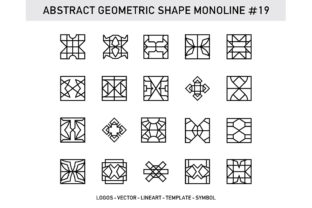
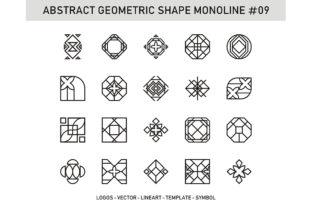
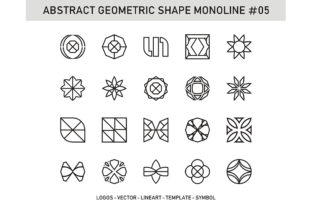
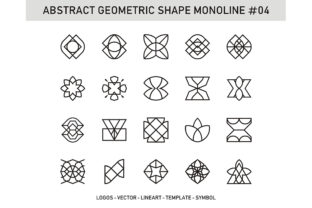
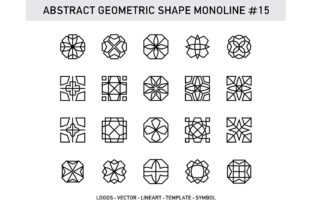
Abstract Geometric Shape Monoline 15 is a curated collection of fifteen hand-drawn, single-stroke geometric abstractions—circles, intersecting arcs, asymmetric polygons, radial fragments, and fluid angular motifs—all rendered with consistent line weight and intentional negative space. Unlike generative or algorithmically produced shapes, each element in the set was refined through iterative human judgment to balance mathematical structure with organic rhythm. The “Monoline” designation reflects its defining technical trait: uniform stroke thickness across all forms—enabling crisp rendering at any scale, from mobile app icons to large-format environmental graphics.
The set ships as two complementary file formats: an EPS file for full vector editability in Adobe Illustrator, Affinity Designer, or CorelDRAW—and a high-resolution JPG file optimized for immediate use in presentations, mood boards, CMS platforms, or social media templates. This dual-format delivery acknowledges real-world workflow diversity: designers who need to recolor, layer, or integrate into complex illustrations rely on the EPS; content strategists, non-designers, and rapid-deployment teams benefit from the plug-and-play JPG.
Why This Set Fits Today’s Creative and Business Landscape
Three converging trends make Abstract Geometric Shape Monoline 15 especially relevant right now:
- Design Systems Maturation: Organizations no longer treat visual identity as static logos and color palettes—they build scalable, component-based systems. Monoline shapes serve as foundational “visual atoms”: neutral enough to support diverse applications (UI dividers, data visualization accents, packaging textures), yet distinctive enough to reinforce brand voice when used consistently.
- Remote Collaboration Efficiency: With cross-functional teams working asynchronously across time zones, ambiguity slows progress. A well-documented, stylistically unified asset like Abstract Geometric Shape Monoline 15 reduces interpretation overhead. A marketer can drop the JPG into a Canva template; a developer can reference the EPS path data for SVG implementation—both achieving visual alignment without back-and-forth revision cycles.
- Attention Economy Discipline: Consumers scroll faster, skim deeper, and disengage from visual noise. Monoline geometry delivers cognitive ease: clean contours guide the eye without competing for attention. It supports hierarchy—not decoration. In landing pages, pitch decks, or SaaS dashboards, these shapes subtly frame content, separate sections, or visualize relationships—without demanding focus.
Shifting Needs Behind the Rise of Precision Abstraction
Historically, abstract shapes leaned either toward expressive gestural marks or rigid parametric grids. Today’s professionals require something in between: intentionally restrained, yet human-inflected. Consider how UX writers now collaborate closely with designers to align microcopy tone with visual cadence—or how startup founders curate investor decks where every visual element must reinforce credibility and forward motion. A shape that feels too mechanical reads as cold; one that’s overly irregular undermines trust in execution.
Abstract Geometric Shape Monoline 15 occupies that nuanced middle ground. Its subtle asymmetries—say, a trapezoid with one softened vertex or a concentric ring set with calibrated spacing—signal craftsmanship without calling attention to technique. That distinction matters. When a fintech brand uses one of these shapes as a background motif in its dashboard analytics view, users register coherence and control—not novelty for its own sake.
Practical Applications Across Roles
Real-world usage reveals how context transforms a simple shape into strategic infrastructure:
- For Freelance Brand Designers: Embedding a rotated monoline triangle as a subtle watermark overlay on client presentation slides reinforces visual continuity across touchpoints—without infringing on brand guidelines. The EPS allows quick recoloring to match evolving client palettes.
- For SaaS Product Managers: Using the JPG version of a fragmented arc as a section divider in an in-app onboarding flow creates intuitive visual pacing. Its monoline weight ensures legibility even on low-DPI screens—critical for global user bases.
- For Content Marketers: Layering three monoline circles (from the set) behind key statistics in a LinkedIn carousel post adds dimensionality while preserving text readability. Because all elements share identical stroke weight and proportion logic, the composition feels intentional—not assembled.
- For Print & Packaging Specialists: Scaling the EPS version of a tessellating hexagonal fragment to repeat seamlessly across luxury product boxes achieves tactile sophistication. The single-line construction avoids ink bleed concerns during spot-color printing—a practical advantage often overlooked in digital-first asset libraries.
Beyond Aesthetics: Operational Advantages Built In
What separates Abstract Geometric Shape Monoline 15 from generic clipart or AI-generated shape packs is its operational foresight:
- Consistent Metrics: All shapes are constructed within a standardized artboard grid, enabling predictable spacing, alignment, and responsive scaling—no manual adjustment needed when adapting for dark mode interfaces or multi-language layouts.
- Production-Ready Paths: The EPS contains clean, ungrouped vector paths with no redundant anchor points—reducing file bloat and ensuring compatibility with modern design tools and automated publishing pipelines.
- Contextual Flexibility: Each shape functions equally well as a standalone icon, a repeating pattern base, a masking element, or a compositional anchor. This versatility reduces the need to source multiple disparate assets for a single campaign.
Aligning With Broader Industry Developments
This collection arrives amid growing industry emphasis on design ops maturity—the integration of design, engineering, and business processes into coherent, measurable workflows. As companies invest in design token libraries, Figma plugin ecosystems, and automated style-guide enforcement, assets like Abstract Geometric Shape Monoline 15 become force multipliers: they’re small enough to embed everywhere, yet precise enough to enforce consistency. They reflect a broader shift from “design as output” to “design as infrastructure.”
Technologically, monoline abstraction also anticipates hardware evolution. With foldable displays, variable refresh rates, and AR overlays gaining traction, visual elements must remain legible and harmonious across dynamic contexts. Single-weight geometry scales cleanly across resolutions and maintains perceptual stability under motion—making it future-resilient in ways that textured or gradient-heavy alternatives are not.
Conclusion: Precision as Partnership
Abstract Geometric Shape Monoline 15 succeeds not because it introduces radical new forms—but because it answers quiet, persistent questions faced daily by professionals: How do we communicate complexity simply? How do we maintain visual fidelity across teams and tools? How do we build assets that age well—not just stylistically, but operationally?
Its value lies in restraint executed with care—in the decision to limit stroke variation so that color, placement, and juxtaposition become the primary levers of expression. For creators balancing speed and sophistication, for entrepreneurs building recognizable identities on lean resources, and for teams seeking shared visual language without prescriptive rigidity, this set offers more than decoration. It offers alignment. It offers efficiency. It offers a foundation built to evolve—not expire.
Whether you begin with the EPS file for deep customization or the JPG file for immediate impact, Abstract Geometric Shape Monoline 15 meets you where your workflow lives—and supports where it’s headed.