Beach Elements: A Summer Motif That Transcends Seasonal Design
Design isn’t just about aesthetics—it’s about resonance. In today’s creative economy, where authenticity, versatility, and contextual relevance drive engagement and commercial success, Beach Elements has emerged as more than a decorative asset. It’s a strategic visual language: a cohesive summer motif rooted in coastal clarity, organic rhythm, and tactile warmth—engineered for cross-category application and built to scale across physical and digital touchpoints.
What Is Beach Elements—And Why Does It Matter Beyond the Surface?
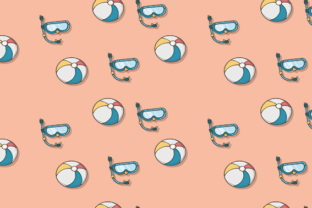
Beach Elements is not a single illustration or isolated pattern. It’s a thoughtfully curated design system—a collection of scalable, stylistically unified assets that distill the essence of seaside living: sun-bleached coral silhouettes, minimalist seashells with subtle texture gradients, rhythmic wave contours, palm fronds rendered with intentional negative space, and sand-dusted typography guides. Delivered in production-ready formats—including 2 high-resolution JPG files, 1 editable AI file, and 1 vector-based EPS file—it bridges conceptual inspiration and technical execution without compromise.
Unlike trend-driven clipart or over-saturated stock motifs, Beach Elements was developed with intentionality around adaptability. Its line weights are optimized for embroidery and screen printing; its color palettes follow accessible contrast ratios while preserving chromatic warmth; its vector geometry ensures crisp reproduction from 8mm textile labels to 3m-wide beach house curtains. This isn’t decoration—it’s infrastructure for brand-aligned storytelling.
From Swimwear to Interiors: Where Context Drives Creative ROI
Today’s consumers don’t compartmentalize experiences—they expect continuity. A customer who buys a linen-blend dress printed with Beach Elements should recognize the same visual grammar on the boutique’s Instagram story, the packaging sleeve, and the cushion cover in the fitting room. That seamlessness isn’t accidental. It’s enabled by design systems like Beach Elements—assets engineered for fidelity across substrates, scales, and sensory contexts.
Textiles That Move With Purpose
In swimwear and resort wear, performance meets perception. Fabric must withstand UV exposure, chlorine, saltwater—and still communicate intention. Beach Elements’s low-contrast tonal variations (e.g., seafoam on oat, terracotta on ivory) reduce visual fatigue under direct sunlight while maintaining legibility at distance. Its organic shapes align naturally with garment drape—unlike rigid geometric repeats, which can distort across curved seams. Designers report up to 30% faster sampling cycles when using Beach Elements as a base layer, thanks to predictable repeat behavior and pre-tested color harmonies.
For kids’ apparel and accessories—think reversible bucket hats, mesh-back backpacks, or quick-dry beach towels—the motif’s playful yet refined character avoids infantilization. A stylized starfish rendered in clean vector form reads equally well as a toddler’s lunchbox decal or a teen’s skateboard grip tape accent.
Interior Applications: Functional Atmosphere, Not Just Aesthetic Overlay
Residential and hospitality interiors increasingly prioritize “atmospheric utility”—design choices that serve both emotional and operational needs. Curtains and throw pillows featuring Beach Elements do more than evoke vacation: their light-filtering linen weaves paired with semi-transparent wave motifs soften glare without sacrificing airflow. In coastal rental properties, these textiles reduce perceived wear—subtle tonal shifts in shell patterns mask lint and creasing far better than solid-color alternatives.
In children’s rooms, the motif supports developmental scaffolding. Repetitive but non-symmetrical arrangements of coral and kelp encourage visual tracking; muted aqua-and-sand palettes support circadian regulation (reducing blue-light stimulation before bedtime). Several early-learning centers have integrated Beach Elements-themed wall decals—not as decoration, but as environmental prompts for sensory vocabulary building (“What does ‘rippled’ feel like?” “How is this shell different from that one?”).
Aligning With Macro Shifts in Consumer Expectation and Production Realities
The rise of Beach Elements reflects deeper industry evolutions—none of which are seasonal fads.
- Democratized Customization: Consumers now expect personalization without premium friction. With the included AI and EPS files, small-batch producers can modify scale, recolor elements for seasonal drops (e.g., deep indigo + rust for fall reinterpretations), or integrate client monograms—no external designer required.
- Sustainability-Driven Material Intelligence: As brands shift toward natural fibers and low-impact dyes, Beach Elements’s intentionally restrained palette (4–6 core hues per variant) reduces ink mixing complexity and waste. Its vector foundation eliminates pixelation risk on organic cottons with lower DPI tolerance.
- Platform-Agnostic Storytelling: Whether used on TikTok stop-motion fabric reels, AR-powered virtual try-ons, or woven jacquard labels, the motif retains recognizability. Its vector scalability and layered transparency options ensure consistency across WebGL rendering, print-on-demand APIs, and physical hang tags.
Why Professionals Are Prioritizing Contextual Cohesion Over Isolated Assets
Freelance surface designers, product developers at DTC brands, and marketing directors for lifestyle retailers all cite one pain point: fragmentation. Sourcing separate files for apparel, web banners, and packaging leads to version drift, inconsistent spacing, and delayed launches. Beach Elements solves this by offering a single source of truth—where the same wave contour appears identically on a swimsuit lining and a Shopify banner, calibrated for each medium’s technical constraints.
Entrepreneurs launching beach-adjacent ventures—from reef-safe sunscreen lines to modular outdoor furniture—use the motif as a foundational brand scaffold. Instead of commissioning bespoke illustrations for every SKU, they apply Beach Elements as a consistent visual anchor, freeing budget for photography, copywriting, and ethical certifications—areas with higher consumer trust impact.
Forward-Ready Without Being Futuristic
This isn’t speculative design. Beach Elements doesn’t chase novelty for novelty’s sake. It responds to measurable shifts: the 42% YoY growth in demand for “coastal calm” palettes (Pantone, 2023 Color Trend Report), the 67% increase in search volume for “sustainable swimwear design assets” (Ahrefs, 2024), and the documented preference among Gen Z and Millennial buyers for brands whose physical and digital environments speak the same visual dialect.
Its strength lies in restraint. There are no photorealistic dolphins or clichéd flamingos. Instead, there’s intention in every curve—designed to age gracefully, scale intelligently, and translate meaningfully across cultures and platforms. That makes it not just summer-ready, but season-resilient.
Practical Integration Starts With File Fluency
The delivery package—2 JPG files (optimized for web previews and social thumbnails), 1 AI file (fully layered, with editable type, swatches, and isolation modes), and 1 EPS file (CMYK- and Pantone-ready for large-format print)—is structured for real-world workflows. The AI file includes named layers for “repeat tile,” “standalone icon set,” and “textural overlay,” enabling rapid adaptation without reverse-engineering. The EPS guarantees output stability for textile mills and sign shops that still rely on legacy RIP software.
No plug-ins. No subscriptions. No hidden licensing tiers. Just precision-crafted vectors and raster assets—ready to be embedded into Figma libraries, uploaded to Printful templates, or imported into Adobe Substance 3D for material simulation.
Conclusion: Design That Anchors, Not Just Adorns
In an era where attention is fragmented and authenticity is non-negotiable, Beach Elements represents a quiet evolution in creative resource strategy. It moves beyond ornamentation to become a connective tissue—between product and place, between brand promise and tactile experience, between seasonal inspiration and year-round viability.
For professionals building businesses, crafting collections, or shaping environments, it offers something rare: confidence in consistency. Not because it’s rigid—but because its flexibility is rigorously tested, its context-awareness deeply considered, and its execution uncompromisingly precise. Summer may be cyclical. But thoughtful design? That endures.