Why the Christmas Plaid Digital Paper Pack Is Reshaping Creative Workflows This Holiday Season
In today’s fast-paced creative economy—where speed, versatility, and visual cohesion drive real business outcomes—the Christmas Plaid Digital Paper Pack isn’t just another seasonal asset. It’s a strategic tool reflecting deeper shifts in how professionals design, brand, and deliver holiday-themed content across digital and print channels. Whether you’re a freelance graphic designer crafting custom invitations, an e-commerce entrepreneur updating product packaging, or a marketing team scaling festive campaigns across social, email, and physical touchpoints, this pack answers a growing need: high-fidelity, on-brand, production-ready texture without compromise.
A Resource Designed for Real-World Creative Demands
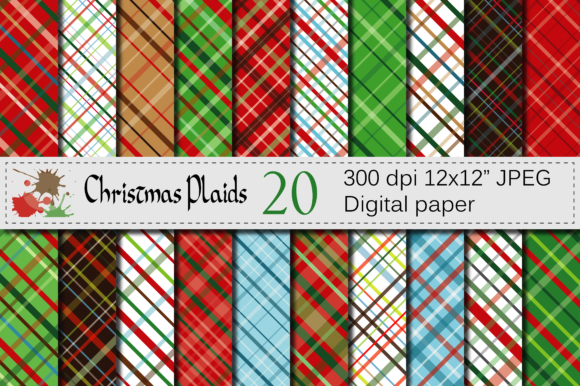
The Christmas Plaid Digital Paper Pack delivers 20 high-quality 300dpi 12×12 JPEG files—watermark-free, print-safe, and optimized for both screen and press. Unlike generic clipart or low-res downloads, each file is purpose-built with intentional color harmony: rich reds, forest greens, warm browns, crisp blues, and clean whites—colors that align with modern holiday aesthetics while avoiding dated clichés. These aren’t random patterns; they’re plaid geometric designs calibrated for balance, rhythm, and scalability—making them ideal not only for traditional scrapbooking but also for UI overlays, Shopify banner backgrounds, printable gift tags, branded merchandise mockups, and even textile-inspired social media templates.
What sets this pack apart isn’t just resolution or quantity—it’s contextual readiness. In an era where creators juggle multiple platforms, file formats, and output requirements, having assets that work seamlessly across Canva, Adobe Photoshop, Affinity Designer, Procreate, and even web-based editors eliminates friction. No re-sampling. No licensing ambiguity. No time lost sourcing, editing, or clearing rights. Just drag, drop, and deploy—with confidence in consistency and quality.
Aligning With Broader Industry Shifts
This level of intentionality mirrors larger movements across design and marketing. First, there’s the rise of “hybrid production”: creatives no longer choose between digital-only or print-first workflows—they build assets that serve both simultaneously. The Christmas Plaid Digital Paper Pack supports that duality: its 300dpi resolution ensures sharpness on premium greeting cards and photo books, while its JPEG format guarantees compatibility with CMS platforms, email builders, and digital ad tools.
Second, consumer expectations around authenticity and craftsmanship are rising—even during holidays. Shoppers increasingly favor brands that signal care through tactile details: embossed stationery, woven fabric labels, textured packaging. Digital papers bridge that gap virtually. A well-placed plaid background in an Instagram Story conveys warmth and tradition; the same pattern repeated as a subtle watermark on a downloadable planner reinforces premium positioning. It’s visual storytelling at the pixel level—and it matters.
Third, sustainability is reshaping creative procurement. Physical sample books, printed swatch kits, and disposable mockup assets generate waste and delay. Digital paper packs like this one reduce environmental impact while accelerating iteration cycles. Designers can test five plaid variations against a product label in under two minutes—no shipping, no inventory, no landfill-bound proofs.
Meeting Evolving Professional Needs
Freelancers and agencies face tighter deadlines and broader scope. Clients now expect full campaign packages—not just logos or banners, but cohesive suites: email headers, printable coupons, Instagram carousel templates, and printable activity sheets for retail loyalty programs. The Christmas Plaid Digital Paper Pack serves as a foundational layer across all those outputs. Its geometric structure lends itself to repetition, cropping, tiling, and layering—enabling rapid customization without sacrificing aesthetic integrity.
For entrepreneurs launching holiday collections, consistency is currency. Imagine using one plaid variant for your Etsy shop banner, another as a background for your “Limited Edition” badge, and a third as a subtle texture behind your product photography. That kind of visual continuity builds recognition faster than any algorithm—and it starts with smart, reusable assets.
Even educators and nonprofit organizers benefit. A children’s ministry might use these papers to design Advent calendars or printable devotion cards. A small-batch candle maker could apply them to downloadable recipe cards or QR-code-enabled gift tags. The versatility isn’t theoretical—it’s baked into the file structure, color palette, and resolution.
Practical Integration Across Key Use Cases
- Scrapbooking & Memory Keeping: These papers provide archival-grade textures for digital scrapbook kits—ideal for hybrid crafters who blend printed photos with layered digital elements. Their geometric precision ensures clean edges when cutting with Cricut or Silhouette machines.
- Product Design & Packaging Mockups: Apply them directly to 3D packaging templates (e.g., in Blender or Adobe Dimension) to visualize how plaid wraps around mugs, boxes, or tote bags—critical for pre-launch stakeholder reviews.
- Invitations & Stationery: Layer them beneath elegant typography in Canva or Illustrator to create luxe, tactile-feeling digital invites—then export at full resolution for professional printing services like Moo or Vistaprint.
- Social Media & Email Campaigns: Crop sections for Instagram post backgrounds, Pinterest pin templates, or animated email headers. Their balanced contrast ensures readability over text—even at small sizes.
- Educational & Community Resources: Use them as base layers for printable checklists, holiday planners, or classroom activity sheets—adding visual warmth without overwhelming young learners or busy parents.
Technology Meets Tradition—Without Compromise
There’s a quiet revolution happening in seasonal design: moving away from nostalgic pastiche toward contemporary reinterpretation. Today’s consumers appreciate tradition—but they expect it filtered through clarity, inclusivity, and intention. The Christmas Plaid Digital Paper Pack reflects that evolution. Its color combinations avoid oversaturation and seasonal fatigue—opting instead for grounded, livable tones that pair effortlessly with neutrals, metallics, or even unexpected accents like mustard yellow or charcoal gray.
Technologically, JPEG remains the most universally supported raster format—ensuring broad compatibility across legacy systems, mobile apps, and emerging AI-assisted design tools. While some creators explore generative pattern tools, those often lack the curated balance and cultural resonance of professionally designed plaid geometries. This pack offers the best of both worlds: human-led art direction with machine-ready execution.
Looking Ahead: Why This Matters Beyond the Holidays
While rooted in seasonal relevance, the Christmas Plaid Digital Paper Pack signals something more enduring: the growing value of modular, reusable, context-aware design systems. As creative professionals shift from project-based work to ongoing brand stewardship, assets must be durable—not just festive. These papers can be adapted year after year: recolored via adjustment layers, combined with new typography systems, or repurposed as part of broader brand texture libraries.
They also reflect a maturing digital creative ecosystem—one where quality isn’t assumed, but verified. At 300dpi, these files meet commercial print standards. Their JPEG format avoids transparency complications common with PNGs in certain CMS environments. Their zip delivery ensures secure, organized access—no fragmented cloud links or expiring download pages.
In short, the Christmas Plaid Digital Paper Pack is more than a convenience. It’s evidence of how thoughtful digital resource design meets real-world professional needs—accelerating output, elevating perception, and supporting sustainable, scalable creativity. For anyone building, branding, or sharing something meaningful this season—and beyond—it’s not just useful. It’s necessary infrastructure.