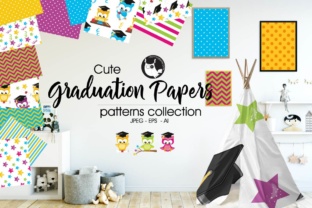
Graduation Papers: High-Quality Pattern Backgrounds for Real Projects
Graduation Papers isn’t just another collection of decorative graphics—it’s a thoughtfully assembled set of versatile, print-ready pattern backgrounds designed for people who need polished, professional visuals without the time or expertise to build them from scratch. Whether you’re designing a graduation announcement, launching a boutique stationery line, updating your classroom materials, or building a branded digital course, Graduation Papers delivers clean, joyful, and unmistakably high-quality patterns that work immediately.
When You Need More Than “Cute”—You Need Consistency and Control
Think about the last time you spent 45 minutes scrolling through free design sites, only to find patterns that were either pixelated, overly busy, or locked behind confusing licenses. Graduation Papers solves that—not with flashy promises, but with practical files you can open, edit, scale, and deploy across real workflows. The set includes one EPS vector file and one Adobe Illustrator (.ai) file—both fully layered and editable—so designers can tweak colors, adjust spacing, or isolate motifs in seconds. And because every graphic is also saved individually as a 300 DPI JPEG, non-designers (like teachers, small business owners, or event planners) can drop them straight into Canva, PowerPoint, Word, or even a photo printer without wrestling with software.
Real People, Real Uses—Not Just Stock Scenarios
A freelance educator in Austin uses Graduation Papers to refresh her end-of-year student certificates—replacing generic clip art with subtle, joyful patterns that feel personal but still uphold school branding. She opens the JPEGs directly in Google Slides, overlays names and dates, and prints on matte cardstock. No designer needed. No licensing anxiety.
A wedding planner in Portland builds custom “graduation brunch” invites for clients’ families. She pulls the vector file into Illustrator, recolors a floral motif to match the graduate’s school colors, then exports a seamless tile for the background of a digital RSVP card—and reuses the same motif as a border on printed napkins. One source file, multiple touchpoints.
A small-batch sticker shop owner in Nashville licenses Graduation Papers for seasonal product drops. She isolates individual elements (a bow, a cap, a confetti burst) from the layered .ai file, arranges them into new sticker sheets, and exports print-ready PDFs for her local printer—all while keeping the original patterns intact for future use.
Why “Super Cute” Alone Isn’t Enough—And Why This Is
Cuteness fades if it doesn’t hold up under real conditions. A pattern might look charming at thumbnail size—but fail when scaled to a 24×36 poster, or blur when printed on textured paper, or clash with body text in a newsletter. Graduation Papers avoids those pitfalls by prioritizing clarity, balance, and technical readiness. Every pattern is built with generous negative space, intentional rhythm, and color palettes that support legibility—not just aesthetics. That means when you place white text over a soft watercolor-inspired background, it actually reads. When you tile a geometric motif across a full-page Instagram Story, it aligns cleanly edge-to-edge. When you shrink a detailed motif down to a 1-inch icon for a mobile app, the lines stay crisp.
What to Consider Before You Use Graduation Papers
If you’re working in a highly regulated environment—like a university communications office or a corporate HR team—check whether your brand guidelines allow third-party pattern assets before applying them to official materials. Graduation Papers is licensed for commercial use, but some institutions require internal asset approval first.
If you’re not using Adobe Illustrator or don’t plan to edit vectors, stick with the JPEGs. They’re optimized for immediate use—not just resolution, but color profile (sRGB for digital, CMYK-ready for print), file naming (e.g., “cap-confetti-light-blue.jpg”), and consistent dimensions (all 300 DPI, minimum 4000px on the longest side). No guesswork, no resizing surprises.
If you’re pairing these patterns with photography, test contrast early. Lighter patterns (like pastel gingham or soft chalk doodles) pair well with warm-toned photos; bolder motifs (think bold line-art caps or layered ribbon swirls) hold up better against high-contrast or black-and-white imagery. Graduation Papers includes both ends of that spectrum—so you’re covered whether you’re designing for a sun-drenched outdoor grad photo shoot or a moody studio portrait series.
More Than Just Backgrounds—A Toolkit for Meaningful Moments
Graduation Papers works because it meets people where they are—not where marketing copy says they *should* be. A homeschool parent uses the vector file to create personalized “I Finished 8th Grade!” banners—changing fonts, swapping out icons, and printing on fabric for a backyard celebration. A nonprofit youth program coordinator adapts the patterns into bilingual graduation program covers—translating text in InDesign while keeping the visual identity cohesive and uplifting. A blogger documenting her own adult degree completion uses the JPEGs as subtle headers in her Medium posts, giving her narrative visual warmth without distracting from her story.
Even in fast-moving digital spaces, consistency matters. One social media manager for a community college uses the same cap-and-tassel motif across LinkedIn carousels, Instagram highlight covers, and email headers—creating instant recognition across platforms without needing a full brand refresh. The vector file lets her export SVGs for web use and PNGs with transparent backgrounds for stories—no extra plugins, no trial-and-error.
Getting Started Is Simpler Than You Think
You don’t need to master Illustrator to benefit from Graduation Papers. Start with the JPEGs: drag one into Canva, set it as a background layer, lock it, and add your text or logo on top. Want more flexibility? Open the .ai file—even if you’ve never used Illustrator before, you can select individual layers (like “borders,” “icons,” or “full patterns”) and hide or recolor what you don’t need. The EPS file? Keep it as your master archive—scalable to billboard size, compatible with older versions of design software, and safe for long-term archiving.
And because each graphic is saved individually, you’re never stuck with a “pattern pack” you have to dissect. Need just the laurel wreath? It’s there. Only want the minimalist diploma icon? Grab it. Prefer the confetti version in navy instead of coral? Edit it once, save it, and reuse it across ten projects.
Graduation Papers isn’t about making things “look finished.” It’s about removing friction so your message, your student, your brand, or your celebration stays front and center—while the design quietly does its job: clear, confident, and quietly joyful.